Sportsman
Oct 14, 2025

Conservation conversations often start in the wrong place.
They focus on access before habitat. Entitlement before economics. Public land before the private ground that quietly holds much of the West together.
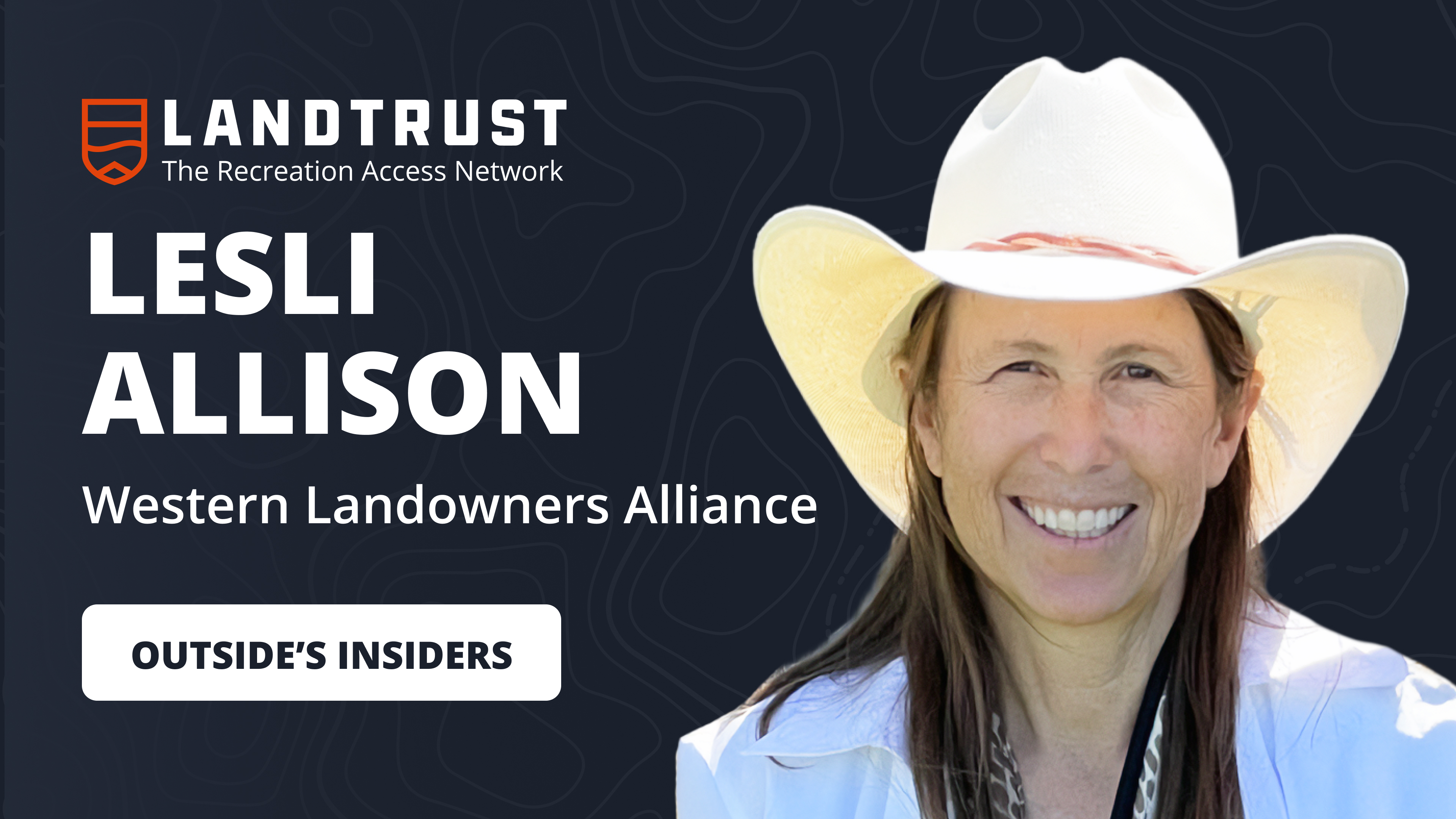
In this episode of the LandTrust Podcast’s Outside's Insider series, Nic De Castro sits down with Lesli Allison, CEO of the Western Landowners Alliance, to talk about the part of conservation that rarely gets the spotlight: working lands, private landowners, and the financial reality of keeping landscapes intact.
Lesli has spent more than three decades working alongside ranchers, farmers, and landowners across the West. Her perspective is shaped not by theory, but by lived experience—managing a Colorado ranch, restoring forests, running livestock, and watching her own beliefs about land, hunting, and stewardship evolve.
Lesli’s journey into land stewardship wasn’t planned.
She grew up in New Mexico, roaming national forest land with a deep love for wild places—but little appreciation for activities like logging, hunting, or grazing. Those things felt like intrusions.
That worldview changed when she helped manage a large ranch in southern Colorado.
“What I thought I knew about land and conservation completely flipped,” Lesli explains. Over sixteen years on the ranch, she came to understand how livestock grazing, hunting, and active forest management weren’t threats to the land—but often the very tools that kept it healthy.
She oversaw large-scale forest restoration projects, ran cattle, learned to hunt, and watched how working lands held wildlife habitat together in ways few protected areas could on their own.
That experience eventually led her to the Western Landowners Alliance, a landowner-led network focused on pragmatic, place-based conservation solutions across eleven Western states.
A simple fact frames much of the conversation: most of the West’s best wildlife habitat is privately owned.
Valley bottoms, riparian corridors, winter range, and migration routes—the most biologically productive landscapes—were settled first. Those lands became private, while public lands often occupy higher, harsher terrain.
Wildlife doesn’t recognize fence lines. Elk, deer, and other species rely on private lands for critical stages of their life cycles, especially during winter.
“When we lose private land habitat,” Lesli says, “we don’t just lose acreage—we lose connectivity.”
As development fragments working lands, wildlife populations suffer. Fewer animals, fewer migration routes, and ultimately fewer hunting opportunities—on both private and public land.
The hardest truth in conservation is also the simplest: land has to pay for itself.
Property taxes, insurance, infrastructure, water systems, fence maintenance—it all adds up. Even landowners who are “land rich” often operate on razor-thin margins.
“If the land doesn’t generate income,” Lesli explains, “it eventually gets sold. And once it’s subdivided or developed, it rarely comes back.”
Agriculture remains the primary economic driver on most Western ranches. Recreation—especially hunting—is often the second. Together, they form the financial backbone that keeps large landscapes intact.
Remove that economic viability, and conservation collapses.
One of the most eye-opening moments in the conversation comes when Lesli shares findings from a recent landowner investment study conducted by Western Landowners Alliance.
In 2024 alone, private landowners across eleven Western states invested over $400 million of their own money into conservation—habitat restoration, rangeland health, forest management, and wildlife projects.
That figure doesn’t include land acquisition costs, property taxes, or production expenses. It’s pure out-of-pocket conservation investment.
“These landowners are quietly funding conservation at a scale that rivals or exceeds many public and nonprofit programs,” Lesli notes.
Yet their role is rarely acknowledged.
Much of the tension between landowners and sportsmen comes down to economics.
Species like elk place real costs on working lands: broken fences, lost forage, damaged crops, and disease risks. Without a way to offset those costs, wildlife becomes a liability.
But when wildlife can generate revenue—through managed hunting, recreation, or access—it becomes an asset worth investing in.
“If wildlife pays, it stays,” Nic adds.
That shift changes everything. Landowners invest in habitat. Wildlife populations stabilize. Pressure disperses across landscapes, benefiting public-land hunters as well.
Lesli challenges the idea that conservation should be tied exclusively to free public access.
Unlimited pressure, she notes, often degrades habitat and hunting quality—on both sides of the fence. Meanwhile, well-managed private lands can offer high-quality, low-impact opportunities that support conservation financially.
“It’s not about excluding people,” she says. “It’s about aligning incentives so land stays whole and wildlife thrives.”
That alignment, she argues, is essential for the future of hunting.
Despite the rhetoric that often dominates online debates, Lesli remains optimistic.
She sees landowners and sportsmen as natural allies—both invested in wildlife, habitat, and long-term access.
“When we stop ‘othering’ each other and start talking honestly about costs and responsibilities,” she says, “real solutions emerge.”
Private landowners already carry much of the conservation burden in the West. Recognizing—and supporting—that role may be the most important step toward ensuring hunting, wildlife, and working lands endure for generations.
Because in the end, conservation doesn’t live in ideology.
It lives on the land.