Sportsman
Jul 1, 2026

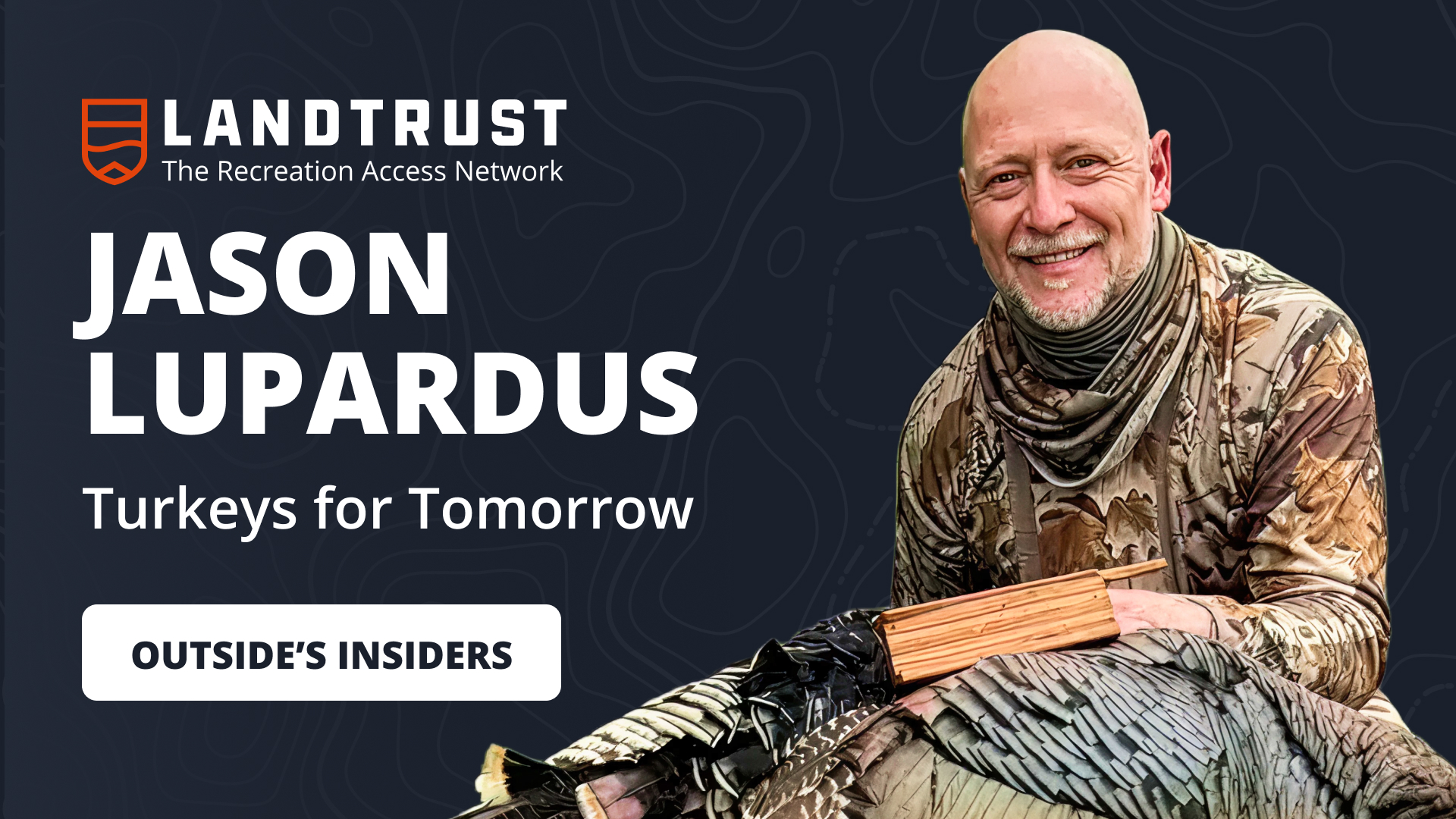
Jason Lupardis doesn’t tiptoe around his motivation.
“I love to turkey hunt,” he says plainly. “And if we don’t have turkeys, it gets pretty hard to hunt them.”
That honesty is part of what makes Jason effective. As CEO of Turkeys for Tomorrow (TFT), he sits at the intersection of science, habitat management, and grassroots action—working to reverse wild turkey population declines across the eastern United States. But at its core, his work is driven by something simple: making sure future generations can experience the same thunderous gobbles and spring mornings that hooked him decades ago.
In this episode of the LandTrust Podcast’s Outside’s Insider series, Jason and LandTrust founder Nic De Castro dig into why wild turkeys are declining, why private land is the key to fixing it, and why conservation only works when landowners are truly part of the solution.
Wild turkeys once represented one of the greatest conservation success stories in North America. After near-extinction in the early 1900s, restoration efforts brought birds back across much of their historic range.
But over the last decade, something changed.
Across the coastal plain, the Southeast, the Mississippi River Valley, and parts of Texas and Oklahoma, turkey numbers began to slide. Hunters noticed it first. Gobbles were fewer. Birds disappeared from places that once held them consistently.
Behind the scenes, biologists saw it too.
“State agencies were concerned long before it was talked about publicly,” Jason explains. “But by the time harvest data shows a problem, you’re already a couple years behind.”
That lag—combined with limited research dollars and fragmented efforts—created a gap Turkeys for Tomorrow was built to fill.
One number frames the entire conversation: 87% of land in the eastern U.S. is privately owned.
“If we’re only focusing on the 13% that’s public,” Jason says, “we’re missing where the real impact has to happen.”
Turkeys don’t recognize property boundaries. A single bird’s home range can cover two to four square miles—roughly 2,500 acres—often spread across dozens of ownerships. The average landowner might only control 50 or 100 acres.
That reality makes cooperation essential.
“Your bird today might be on your neighbor tomorrow,” Jason explains. “If you’re not working together, you’re not managing the population—you’re just managing a piece of it.”
Unlike public-land projects, private-land conservation doesn’t require new legislation or years of bureaucracy. When landowners understand the value of habitat—and have incentives to improve it—change can begin immediately.
Jason’s background reflects this hands-on approach. From state agencies to the National Wild Turkey Federation to private consulting, he’s spent nearly two decades working directly with landowners.
What he learned early is that many landowners don’t need convincing—they need clarity.
“Some folks want a full written plan,” he says. “Others start cutting trees the week after you meet them.”
These landowners aren’t passive recipients of conservation—they’re active participants. Jason calls them citizen scientists: people observing wildlife daily, experimenting with habitat practices, and learning what actually works on the ground.
That real-world feedback often moves faster than academic research alone.
“Our goal is to create incubators of success,” Jason says. “Places where landowners working together are producing birds—and others can learn from it.”
One of the most powerful conservation tools isn’t regulation—it’s economics.
“If wildlife pays, it stays,” Nic notes during the conversation, referencing lessons long observed in African conservation models.
On private land, habitat costs money. Prescribed burns, planting, predator management, and foregone agricultural use all require investment. When wildlife has no tangible value, those investments are harder to justify.
But when landowners can generate income from healthy wildlife populations—through hunting access, leases, or short-term bookings—the equation changes.
“What was an unrealized asset becomes a realized one,” Nic explains. “And once that happens, people invest in it.”
That philosophy sits at the heart of LandTrust’s partnership with Turkeys for Tomorrow.
Through the partnership, every turkey hunt booked on LandTrust includes a $10 conservation contribution that goes directly to Turkeys for Tomorrow.
It’s a simple model with compounding impact.
Hunters book hunts they already want to pursue. Conservation funding scales naturally with demand. And the dollars flow to an organization focused squarely on solving the turkey decline problem—especially on private land.
“It’s a perennial funding mechanism,” Nic says. “As LandTrust grows, support for turkey conservation grows with it.”
For Jason, the model represents more than funding—it’s alignment.
“The people chasing turkeys are helping ensure there are more turkeys to chase,” he says.
Much of turkey conservation comes down to fundamentals.
Nest cover. Brood habitat. Reduced disturbance during critical periods. Simple practices—like delaying mowing until after nesting season—can make a massive difference.
“These aren’t complicated ideas,” Jason says. “But timing matters.”
The future, he believes, lies in personalized guidance—meeting landowners where they are with region-specific, season-specific recommendations. Not generic newsletters, but actionable prompts that fit their landscape and operations.
When habitat improves for turkeys, it improves for everything else too: quail, deer, songbirds, pollinators.
“It’s all connected,” Jason says. “You fix habitat, and the system responds.”
At its core, Jason sees turkey conservation as something bigger than turkeys.
It’s about community.
Landowners working together. Neighbors benefiting from each other’s efforts. Hunters investing back into the resource they love.
And it’s about legacy.
“What we do on our property doesn’t stay there,” Jason says. “Those birds leave. They benefit other people. That’s conservation at its best.”
For Turkeys for Tomorrow and LandTrust alike, the mission is clear: make conservation practical, profitable, and scalable—so the sound of spring gobbles doesn’t fade into memory.
Because if we want turkeys tomorrow, the work has to happen today.