Landowner
Apr 15, 2026

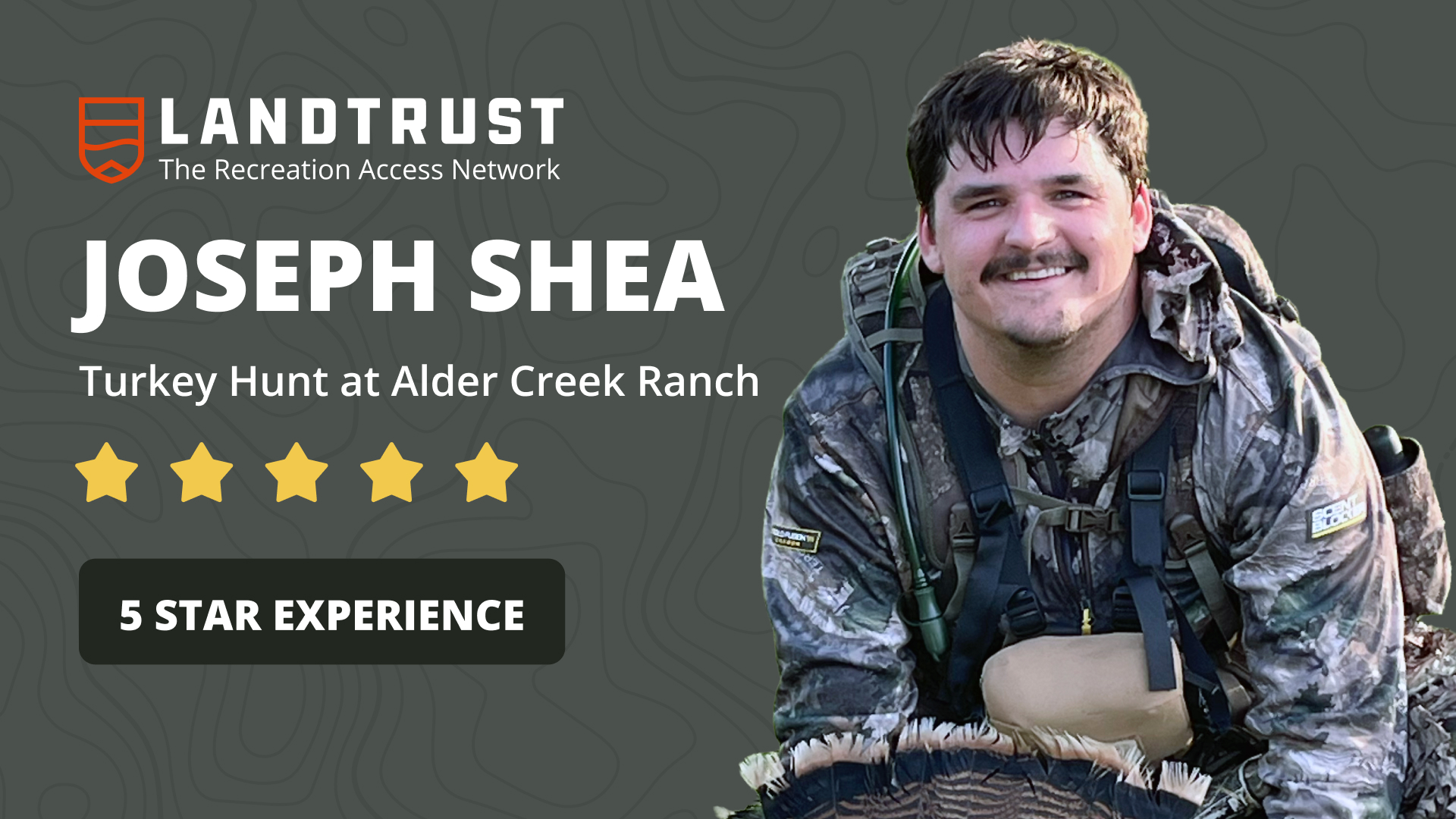
Some hunts are efficient. Some are exhausting. And a rare few turn into the kind of story a hunter carries for the rest of his life — the ones with sweat and scrambling, mistakes and recoveries, and a bird that seems to outsmart you right up until the moment it doesn’t.
For Washington hunter Joseph Shea, his trip to Alder Creek Ranch was all three.
Nestled above the blue sweep of Lake Roosevelt in eastern Washington, the 58-acre property doesn’t look massive on a map. But the land folds and falls into steep ravines, edges into thousands of acres of adjacent BLM ground, and funnels wildlife in ways only people who’ve walked it can understand. It’s a place where a single ridge can turn into an entire day’s pursuit, and where a determined hunter can cover more ground than he ever expected.
For Joseph — who booked the ranch through LandTrust for a much-needed, pressure-free turkey hunt — it was exactly the ground he needed.
A Hunter Between Two Worlds
Joseph lives on the wet, coastal side of Washington, where blacktails vanish into the fog and waterfowl rule the marshes. Turkey country lies far across the state, in the dry pines and sagebrush pockets of eastern Washington — a long drive and a very different landscape.
He’d spent six years teaching himself turkey hunting the hard way. Sleeping in his truck. Hiking into pressured public land. Spending more time scouting than actually hunting. What he lacked in time, he made up for in effort.
But life was shifting. He and his partner were expecting their first child. His free days were shrinking. And he found himself gravitating toward efficiency — not shortcuts, but smarter use of the time he had.
That’s what led him to LandTrust, and eventually to Alder Creek Ranch on a narrow May weekend that happened to coincide with Mother’s Day.
“I needed to be effective,” he said. “And I needed to get home.”
A Small Property That Hunted Big
Joseph pulled in just after sunrise, and immediately saw a tom strutting across the driveway. A good omen, even if it was technically a yard bird.
The landowner met him outside and walked him through the property: where the ridges broke, where birds moved, where boundaries ran, and how the landscape connected directly into thousands of acres of BLM land.
Within minutes, Joseph was easing into the timber, gobbles drifting from both sides of the canyon.
The acreage might have been small, but it hunted big. Deep cuts. Tight brush. Shaded pockets. Long slopes of pine and rock. Each fold held possibility — and each one demanded work.
Joseph climbed ridges, dropped into ravines, and circled steep hillsides that felt almost vertical. More than once he and the same tom seemed to trade places, both creatures circling the terrain in a kind of mountain chess match.
By noon he’d burned through water, elevation, and patience. But the land — and the bird — pushed him to keep going.
The Ridge, the Ravine, and the Tom That Wouldn’t Quit
Joseph wasn’t new to turkey hunting. He’d called in birds. He’d killed birds. But he knew enough to recognize when a gobbler was simply making noise… and when he meant business.
This tom was unpredictable.
One minute he’d gobble across the ravine.
The next he’d appear on Joseph’s side.
Once, Joseph watched him fly across the canyon entirely — a move that suddenly explained the bird’s ability to “teleport.”
By midafternoon, Joseph had chased the same gobble across multiple ridges, sweating through layers and climbing more than he cared to admit.
Exhausted and nearly out of water, he retreated to the cabin, refilled his bottles, talked with the landowners, and seriously considered packing it in.
But he wasn’t willing to leave the day unfinished.
“I knew where the birds were. I just wanted one last good setup.”
The Cul-de-Sac Setup
Late afternoon settled hot and still. Joseph moved to a small cul-de-sac on a ridge — a spot marked with scratchings, tracks, and wing prints where birds had landed. It felt right.
He shifted his decoy three or four times before settling under a worn hawthorn bush. A thorn dug into his palm, but he didn’t move.
Then he waited.
Five minutes.
Fifteen minutes.
Two hours.
He’d call once in a while — soft clucks, purrs, a scratch on the slate — just enough to let the woods know something was there.
A gobble finally echoed in the distance. Then, impossibly fast, another gobble arrived much closer.
Joseph froze.
A Bird in Full Strut
A dark shape appeared on the ridge above him. Full strut. Wing tips dragging. Moving with purpose.
He whispered a few soft chirps. The bird turned. Saw the decoy. Hesitated. Circled. But wouldn’t close the distance.
Joseph could feel the moment slipping.
So he made a choice: he eased a collapsible fan into view and watched the bird bristle… then back off.
That’s when he understood.
“He’d probably been getting beat up all season,” Joseph said. “He wasn’t aggressive. He was defensive.”
The bird dropped off the far side of the knoll. Joseph crawled after him, fan in front of his face, trying to close the gap without blowing the encounter.
He reached the ridge lip, saw a flash of red at eighteen feet, dropped the fan, raised the shotgun, and fired.
The Recovery
The bird tumbled down the backside slope — a long, steep drop into brush near the creek.
Joseph half-slid, half-fell after him.
At the bottom: nothing.
No feathers. No bird. No movement.
Then, under a tangle of vegetation, he spotted the red head. The tom was alive, exhausted, and finished.
A bird earned the hard way.
He climbed back to the ridge, heavy bird over his shoulder. At the top, the landowners greeted him and helped take a few photos — a small, meaningful finale to a long chase.
The Meaning of a Good Hunt
Joseph didn’t use his second day on the property. He’d had his moment. He had his story. And he had a family waiting at home.
Private land hadn’t made the hunt easy.
It had made it pure.
A chance to interact with a wild bird acting naturally, without pressure or competition.
A chance to hunt ethically and safely.
A chance to meet landowners who cared about preserving a tradition they didn’t even personally practice.
“Landownership and recreation don’t have to be in conflict,” he said. “This kind of access keeps hunting healthy — for the land, for the animals, and for the people who still want to be part of it.”
His hunt at Alder Creek Ranch wasn’t just successful. It was demanding, memorable, personal — and exactly the kind of story that keeps the hunting tradition alive.