Sportsman
Jun 11, 2026

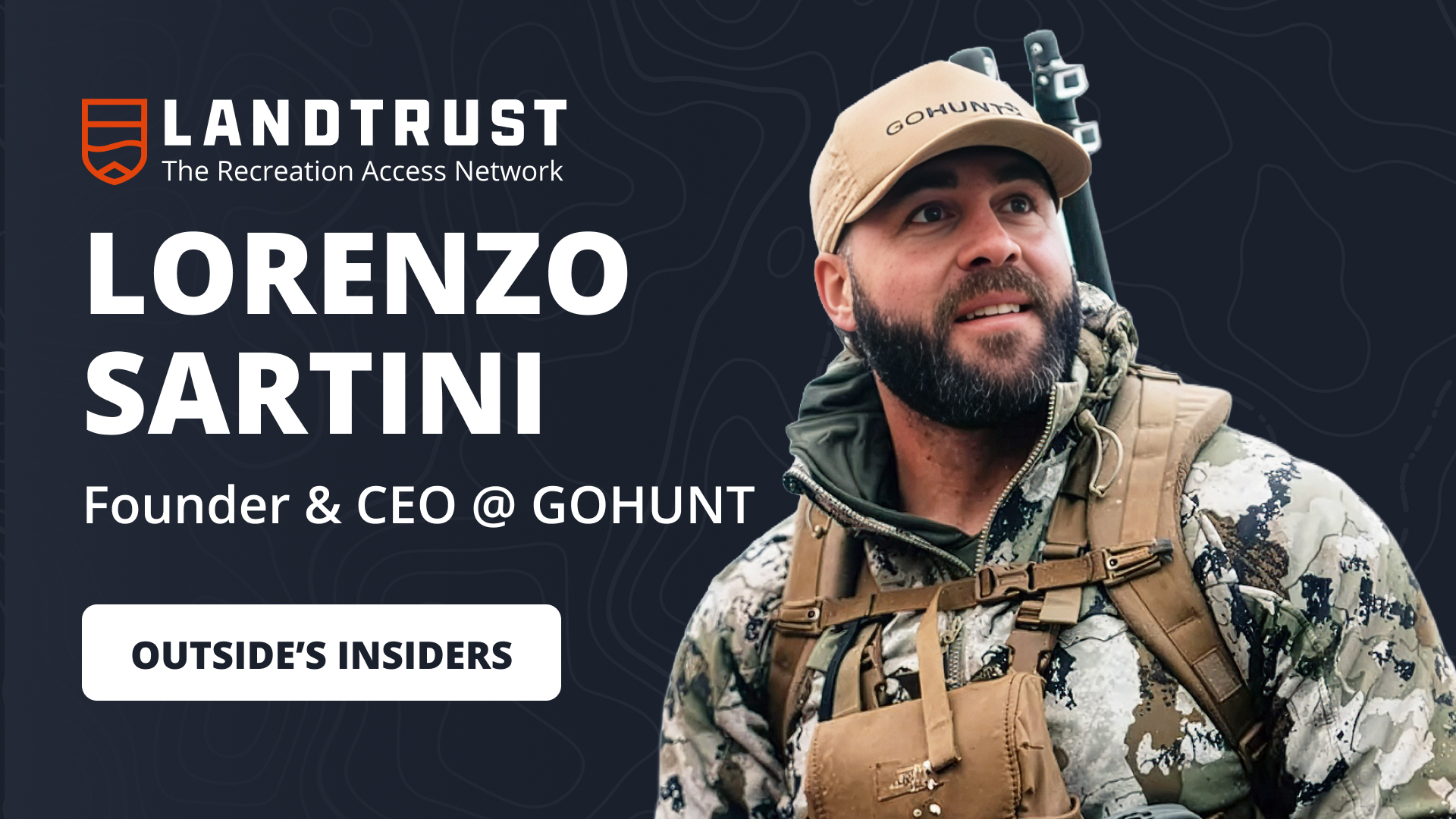
Hunting has never been simple—but today, it might be more complex than ever.
Between draw systems, state-by-state regulations, shifting seasons, and limited time in the field, modern hunters are navigating far more than just terrain. They’re navigating data. And for many, that’s become the hardest part of the hunt.
Few companies understand that better than GoHunt.
In a recent conversation on the LandTrust podcast, founder and CEO Lorenzo Sartini shared how a personal frustration with that complexity turned into one of the most influential platforms in Western hunting—and what it says about where the industry is headed.
Sartini didn’t set out to build a tech company. He set out to hunt more effectively.
Growing up in Nevada, he learned early that in the Southwest, the biggest challenge wasn’t finding animals—it was drawing the tag. Once you had it, the landscape gave you clues: water, cover, and you were in the game.
That changed when he moved to Montana for college.
Suddenly, opportunity felt endless. Tags were easier to come by across multiple states, but success wasn’t. Water was everywhere. Trees were everywhere. Good habitat was everywhere. The challenge wasn’t access—it was knowing where to start.
That contrast stuck with him. It revealed something most hunters eventually learn the hard way: hunting knowledge is highly localized, and without it, even experienced hunters can feel lost.
After college, Sartini returned to Las Vegas and took a job in the casino industry. But his focus wasn’t on the job—it was on planning hunts.
He covered his office walls with printed maps of game management units, studied draw odds, and tried to reverse-engineer the system—figuring out how to maximize opportunity across multiple states and seasons.
To anyone else, it looked like chaos.
To a coworker named Chris Porter, it looked like something else entirely.
As Porter asked questions, Sartini found himself going deeper and deeper into explanations—how draw systems worked, how units compared, how to plan hunts around work schedules and travel. What seemed straightforward to him was, in reality, incredibly complex.
That’s when it clicked.
There was no real digital infrastructure for this level of hunting. No centralized place to plan, research, and execute across the full lifecycle of a hunt. Forums existed. Magazines existed. But nothing that matched the depth hunters actually needed.
GoHunt started there.
What began as a research platform has grown into something much broader—because the problem it set out to solve was never just one piece of the process.
At its core, GoHunt helps hunters answer the most critical question: Where should I go, and how do I get there? That means understanding draw odds, harvest data, unit boundaries, and season timing—all in one place.
But solving that problem exposed others.
Hunters who used the platform to plan their hunts started asking about gear. What boots were they using? What tents? Where could they buy them?
At first, GoHunt simply pointed them elsewhere. But that created a disconnect. The experience ended the moment a hunter left the platform.
So they brought gear in-house.
The same pattern repeated with applications. Missing a deadline can mean missing an entire year of hunting, and the process is often tedious and unforgiving. Instead of leaving that burden on the user, GoHunt built a system to handle it—modernizing what had long been a clunky, paper-driven process.
Even mapping, now a standard tool in hunting, wasn’t approached as a standalone feature. It was integrated into the broader experience, so the same research and planning done months earlier carries through into the field.
Piece by piece, GoHunt evolved into a full ecosystem—not because that was the original plan, but because that’s what the hunter actually needed.
Underneath all of it is a simple truth: hunters don’t have the time they used to.
The image of someone scouting 60 days a year or living out of their truck for a full season is real—but it’s not the norm. Most hunters are balancing careers, families, and responsibilities that limit how much time they can dedicate to planning and preparation.
That’s where technology matters.
The value isn’t just in information—it’s in efficiency. It’s in taking something that used to require weeks of effort and compressing it into something manageable.
In that sense, platforms like GoHunt aren’t changing hunting. They’re making it possible for more people to continue doing it.
If mapping was the first major technological leap in modern hunting, Sartini believes the next one is already here: AI.
Not as a gimmick, but as a guide.
For new hunters—especially those without mentors—AI has the potential to fill a major gap. Instead of spending hours searching forums or piecing together information, they can ask questions and get immediate, structured guidance.
For experienced hunters, it opens a different door. A whitetail hunter in the Southeast might want to chase elk out West but feels overwhelmed by everything they don’t know. AI can help bridge that gap, translating experience from one context into another.
It doesn’t replace the hunt. It just lowers the barrier to entry.
Despite all this progress, the hunting tech space is still highly fragmented.
Most hunters rely on a mix of tools—one for mapping, another for research, another for gear, and yet another for applications. Each solves a piece of the puzzle, but none fully connect the experience.
That fragmentation creates friction, but it also points to where things could go next.
Bringing those pieces together into a more unified system isn’t just convenient—it’s inevitable.
For all the technology, data, and innovation, Sartini remains clear on one thing: the essence of hunting shouldn’t change.
There’s a line between making the process more accessible and removing what makes it meaningful. The goal isn’t to replace skill or experience—it’s to support it.
Because at the end of the day, success isn’t measured in data points or downloads.
It’s measured in time spent outside, and whether you come home with meat for the table.